Freezing-Cold Low Prices on the Horizon!

Our (Pr)eisbrecher servers are clearing the way
for affordable
IT infrastructure.

Our (Pr)eisbrecher servers are clearing the way
for affordable
IT infrastructure.
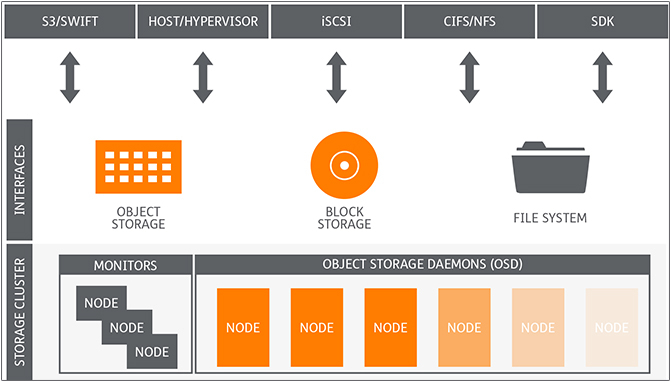
Many companies prefer object-based storage when building large, highly-scalable storage systems as this allows the data volumes to be managed much more efficiently. These systems separate the addressing of the object from the corresponding hardware, which greatly simplifies data migration.
The Crush algorithm from Ceph frees storage systems from the limitation of centrally managed identification tables. This significantly enhances both scalability and speed. A Ceph cluster manages the replication and balance of the data – completely independently and dynamically – without requiring an administrator's involvement in these time-consuming activities. This means that the software automatically distributes and replicates data in the event of unplanned failures of individual drives or entire nodes, as well as when modifying or expanding the storage.
With these server modules, complex storage systems can be easily created that are very powerful and open in their architecture. To simplify the selection for your Ceph cluster, we offer you basic minimum requirements for both monitor (MON) and OSD nodes.
Monitor nodes are tasked with monitoring the system and act as the central management for the Ceph cluster. These servers can also be operated virtually, though, the use of one to three physical monitor nodes is recommended. OSD nodes provide the actual data storage for the objects and can be scaled according to the desired redundancy level. For a replication factor of three, for instance, one will need at least three OSD nodes.
For more technical information on Ceph, please visit our wiki.
The monitor nodes are responsible for monitoring the system and are used for the central management of the Ceph cluster. These servers can also be run virtually; however, it is generally recommended to use one to three physical monitor nodes. The OSD nodes are the actual data storage for the objects and can be scaled as needed depending on the desired level of redundancy. For a replica factor of three, for example, at least three OSD nodes are required.
Virtualization is becoming increasingly important in modern IT infrastructure; thanks to hardware independence and lower energy consumption, significant cost savings can be achieved. Combine Ceph—software for virtually unlimited storage scalability—with the benefits of virtualization using Proxmox, the open-source platform for server virtualization. With our Proxmox Ceph Appliance, we’ve created a hardware and software bundle for you that makes it very easy to store virtual machines (VMs) on Ceph storage. With the flexible Proxmox Ceph Appliance, you’ll benefit from a redundant and highly available storage system (live migration, storage migration, and no single point of failure) as well as the advantages of server virtualization on our systems optimized for Proxmox.
For more technical information about Ceph, please visit our wiki.
 login
login