Freezing-Cold Low Prices on the Horizon!

Our (Pr)eisbrecher servers are clearing the way
for affordable
IT infrastructure.


Our (Pr)eisbrecher servers are clearing the way
for affordable
IT infrastructure.
Those who understand the origins of their IT systems and can assess potential dependencies and risks lay a solid foundation for long-term decisions. Risk management is a central task for companies today and begins with the hardware they use. After all, sovereign software requires sovereign hardware.
Open standards and transparent supply chains help reduce dependencies and ensure a company’s ability to act independently. Manufacturing and support in Germany ensure short supply chains and reliable structures. Durable and scalable systems further help protect investments over the long term and enable companies to respond flexibly to new requirements.
In this interview, Christoph Maier, CSO of Thomas Krenn.AG, offers a brief insight into this approach and highlights the importance of digital sovereignty for companies.
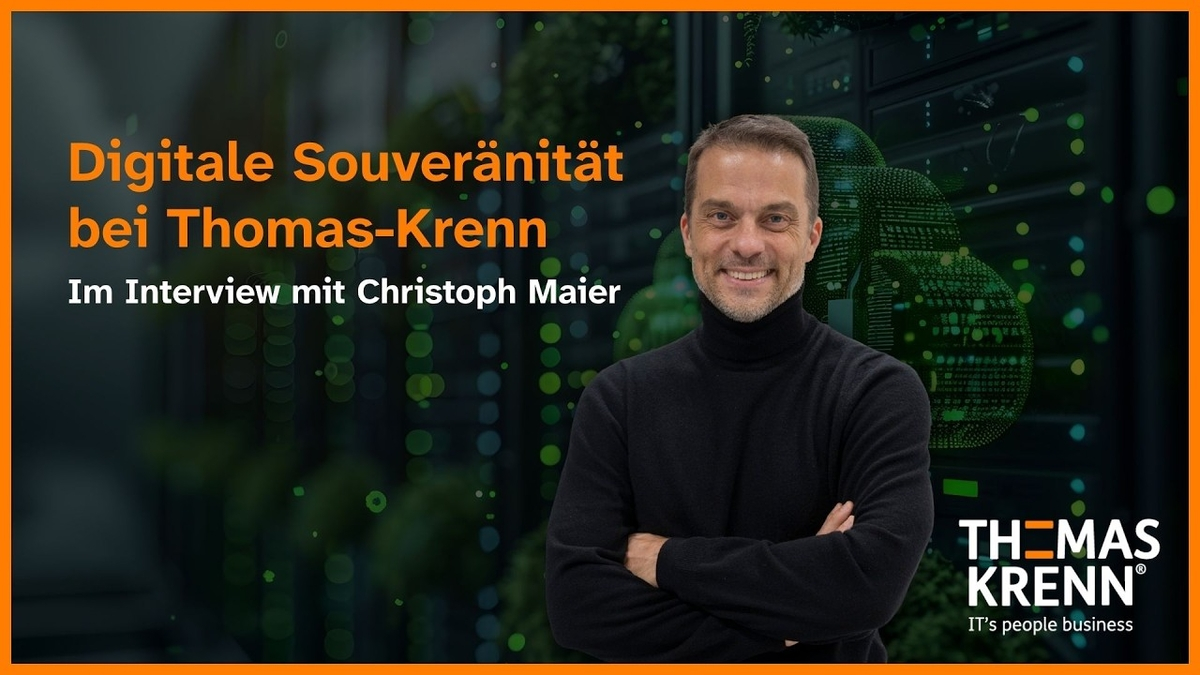
Europe is in the midst of a profound digital transformation. Applications, data platforms, and artificial intelligence are increasingly driving value creation for businesses and public institutions. But every digital application rests on a foundation: hardware.
It is the foundation upon which software can operate reliably, securely, and efficiently. Whoever controls this foundation creates the conditions for security, compliance, and long-term independence.
This brings a crucial question into focus: Who controls the systems on which our digital transformation is based?
Digital sovereignty does not mean producing every single component in-house. It arises through architecture, integration, transparency, and accountability. Since 2002, Thomas-Krenn.AG has been developing custom-configured server and storage systems based on the build-to-order principle—manufactured, tested, and managed in Germany.
This statement is correct—but it doesn’t tell the whole story. No European industry today manufactures all of its semiconductors entirely on its own. What matters, therefore, is not the origin of each individual component, but control over the entire system. The real questions are:
• Who develops the architecture?
• Who integrates the components?
• Who tests, documents, takes responsibility for, and supports the system throughout its entire lifecycle?
Digital sovereignty arises at the system level—not at the chip level.
.
All system architectures are developed and managed in Freyung.
We determine the components, firmware, BIOS configurations, and system design—all tailored to our customers’ specific needs.
In doing so, we consistently rely on open standards. Our systems remain customizable, transparent, and flexibly expandable. This allows customers to avoid proprietary dependencies and maintain long-term control over their infrastructure.
Digital sovereignty also means: no vendor lock-in.
Digital sovereignty thrives on transparency.
Our supply chains are traceable and documentable. Upon request, we provide complete bills of materials and proofs of origin—a decisive advantage for regulated industries and operators of critical infrastructure.
For us, however, transparency does not end with the hardware.
Wherever appropriate, we support open standards and open-source technologies. After all, only open systems enable long-term traceability, adaptability, and independence.
Another key component of this approach is the Thomas Krenn Wiki. For many years, we have been making technical know-how, installation guides, configuration aids, and best practices freely available there. In this way, we promote knowledge transfer, create transparency, and support administrators in operating and further developing their systems independently.
Physical integration, configuration, and testing are carried out entirely at our plant in Freyung.
Every system is inspected, validated, and shipped only after undergoing standardized testing.
Our processes, certified to ISO 9001, ISO 14001, and ISO 27001, ensure that quality is not left to chance but can be tracked and controlled at all times.
Support, warranty, and liability are fully based in Europe.
Our contact persons are based in Germany—with no external call centers and no unclear lines of responsibility.
Systems are configured so that data flows occur exclusively in accordance with our customers’ requirements.
Digital sovereignty does not end with the delivery of a server. It means taking long-term responsibility for secure operation.
.
Digital sovereignty also means economic responsibility. That is why we are making a conscious decision to invest in Germany as a business location—despite higher production costs.
Value creation, jobs, and tax revenue remain where they are generated. At the same time, the geographical proximity between development, production, and support enables a level of quality control that cannot be outsourced.
Our support is provided by our own specialized staff—personally, directly, and with a high level of technical expertise. We do not view service as an add-on, but as an integral part of our quality commitment.
We do not control global semiconductor production—no one in Europe does at present.
But we control what matters most:
the system architecture,
integration,
quality,
the documentation,
support,
and the entire lifecycle.
That is the difference between theoretical dependence and practical digital sovereignty.

ITE – Association for IT from Europe
Digital sovereignty does not arise in isolation, but through collaboration. That is why Thomas-Krenn.AG is actively involved in ITE—a network comprising the business community, research institutions, and the public sector. The goal is to achieve greater transparency regarding the origin, value creation, and security standards of European IT. After all, true sovereignty arises where comparability and clarity are established.
 Development and System Architecture in Freyung (Bavaria)
 Manufacturing, Integration, and Quality Assurance at Our Own Facility
 Open Standards Instead of Vendor Lock-in
 Transparent supply chains and traceable documentation
 Open-Source Expertise and Freely Available Technical Knowledge
  Support, Liability, and Responsibility Under German and European Law
  Personal support from our own team of experts
 Our systems help companies meet regulatory requirements, including:
NIS2-Compliant Supply Chain Transparency
Security and architecture principles aligned with the BSI
GDPR-compliant system and data architectures
Certified processes in accordance with ISO 9001, ISO 14001, and ISO 27001
Europe does not need complete technological self-sufficiency. Europe needs companies that take responsibility—for architecture, quality, transparency, open standards, and long-term support. Digital transformation does not begin in the cloud. It begins on a stable foundation. That foundation is the hardware.
Those who invest in a sovereign IT infrastructure today are laying the groundwork for tomorrow’s security, innovation, and digital self-determination.
That is our understanding of “Made in Germany.” And our contribution to digital sovereignty in Europe.
Whether it’s custom server and storage systems, consulting on NIS2 and supply chain transparency, or projects for critical infrastructure: We support you throughout the entire lifecycle of your systems—personally, directly, and reliably.
From the initial consultation through to ongoing operations, you’ll have a dedicated point of contact at your side—even right at your location.
 login
login